
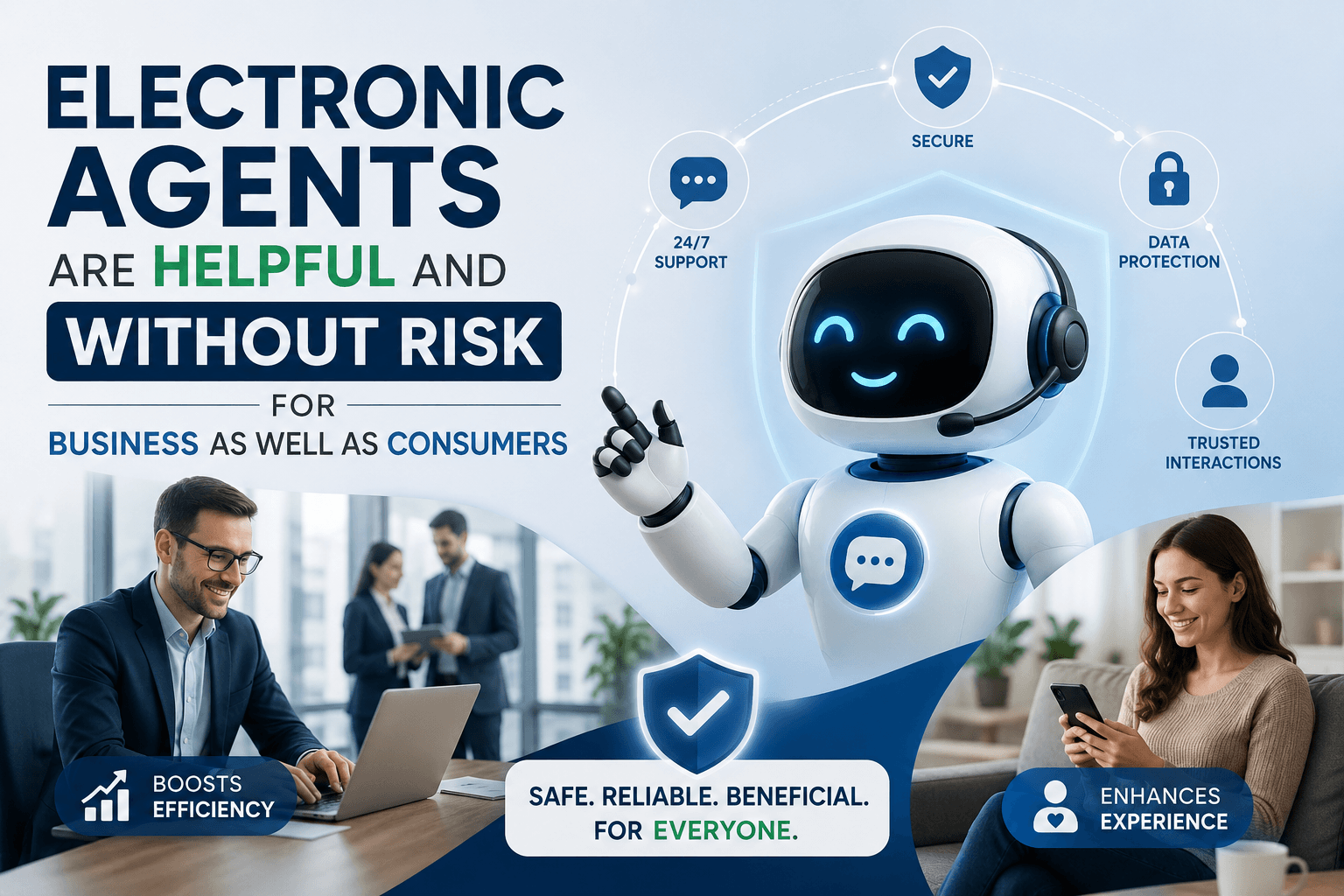
ELECTRONIC AGENTS ARE HELPFUL AND WITHOUT RISK FOR BUSINESS AS WELL AS CONSUMERS
By Sachin Mishra
Introduction
Information Technology (IT) has transformed every aspect of modern life. From withdrawing money through ATMs to purchasing tickets online and making digital payments through credit cards, technology has become inseparable from daily activities. Not only individuals, but businesses and organizations also heavily rely on automated systems for operational efficiency.
Electronic Fund Transfer (EFT) systems, online commerce, and automated stock management have significantly improved business operations. E-commerce has reduced delays, minimized human errors, and increased efficiency through automation and real-time transactions. Former U.S. President Bill Clinton emphasized that technological revolutions such as computers and the internet have fundamentally reshaped communication, trade, and society itself.
Among the major developments in Information Technology, electronic agent technology has emerged as one of the most influential innovations. Electronic agents are capable of autonomously performing tasks within a networked environment. They can react, adapt, learn, and even make independent decisions in certain situations.
However, despite their efficiency and usefulness, electronic agents raise important legal and security concerns. Questions arise regarding their reliability, legal status, and accountability. This article examines the concept of electronic agents, their working principles, associated legal risks, and the appropriate legal responses required to regulate them effectively.
Structure of the Article
This article first explains the meaning and definition of electronic agents by analyzing internationally accepted legal definitions. It then discusses the operational principles of electronic agents and differentiates between various forms of agent technologies.
The article further explores the potential risks associated with electronic agents and the legal challenges posed by their increasing use. Although electronic agents offer immense commercial benefits such as cost reduction and operational efficiency, they also create concerns regarding privacy, security, and legal liability.
Finally, the article evaluates different legal theories concerning the legal status of electronic agents and suggests a balanced legal framework that promotes technological advancement while minimizing associated risks.
Electronic Agents and Their Working Principles
What is an Electronic Agent?
Electronic agents are not unfamiliar to modern society. In fact, individuals interact with them daily, often without realizing it. Search engines such as Google, online shopping assistants, automated customer support systems, and digital payment processors are all examples of electronic agents.
Electronic agents are commonly referred to by different names, including:
- Software Agents
- Intelligent Agents
- Automated Agents
Despite the varied terminology, there is no universally accepted definition of an electronic agent.
Definitions Under International Laws
Several legal instruments have attempted to define electronic agents.
Definition Under UETA (USA)
The U.S. Uniform Electronic Transactions Act (UETA) defines an electronic agent as:
“A computer program or an electronic or other automated means used independently to initiate an action or respond to electronic records or performances without review or action by an individual.”
Definition Under UCITA (USA)
The Uniform Computer Information Transactions Act (UCITA) similarly describes electronic agents as automated systems acting independently on behalf of a person without human intervention at the time of the transaction.
Definition Under UECA (Canada)
The Uniform Electronic Commerce Act (UECA) in Canada also defines electronic agents as electronic means capable of responding to electronic actions without human review.
Essential Characteristics of Electronic Agents
Electronic agents possess several important features:
- Automation and autonomy
- Ability to perform tasks independently
- Capability to communicate with other systems
- Adaptability to changing environments
- Limited or complete absence of human supervision
Modern technological developments have enabled electronic agents to negotiate contracts, gather information, and even perform contractual obligations autonomously.
How Electronic Agents Work
Electronic agents generally operate through two primary models:
1. Stationary Agents
Stationary agents operate within a fixed environment and do not migrate between systems. An electronic calculator is a simple example of a stationary agent. These agents remain under the control of the user and are relatively secure and stable.
Advantages of Stationary Agents
- Greater stability
- Easier management and supervision
- Reduced exposure to external threats
- Better user control
2. Mobile Agents
Mobile agents are more advanced forms of electronic agents capable of moving across different computer networks independently. These agents collect data, execute tasks remotely, and return results to the user.
Features of Mobile Agents
- Autonomous migration across networks
- Ability to gather information independently
- Capability to communicate with external systems
- Reduced network traffic through decentralized processing
Challenges of Mobile Agents
Although mobile agents are highly efficient, they are also difficult to regulate and supervise. Once released into a network, users may lose control over their actions. In some cases, mobile agents may even clone themselves or operate anonymously, increasing legal and security concerns.
Components of Agent Technology
Electronic agent systems depend upon two essential components:
Electronic Agents
Electronic agents are autonomous software programs capable of:
- Negotiating transactions
- Collecting and processing data
- Interacting with digital environments
- Performing assigned tasks independently
Agent Platforms
Agent platforms are the technological infrastructures that support electronic agents. These platforms manage:
- Resource allocation
- Communication services
- Security protocols
- Agent migration and execution
Agent platforms also provide protection against malicious software and unauthorized access.
Potential Risks and Challenges to Legal Rules
Risks Associated with Electronic Agents
While electronic agents provide substantial commercial advantages, they also create several risks.
Modification of Agent Data and Instructions
Electronic agents may be corrupted during storage or transmission. Unauthorized modifications to their code or instructions may alter their behavior and produce harmful outcomes.
Theft of Confidential Information
Electronic agents often process sensitive information such as:
- Credit card details
- Bank account information
- Confidential business data
- Strategic operational instructions
Cybercriminals may exploit vulnerabilities to steal such information.
Disappearance or Failure of Agents
Electronic agents may malfunction, disappear, or fail to complete assigned tasks, resulting in financial losses and operational disruption.
Risks in Mobile Agents
Mobile agents are particularly vulnerable because they operate outside the owner’s direct control and interact with unknown systems and environments.
Risks Associated with Agent Platforms
Security Vulnerabilities
Malicious agents or viruses may attack agent platforms, leading to:
- Data theft
- Unauthorized access
- System corruption
- Manipulation of platform policies
Platform Instability
Since agent platforms are essentially computer systems, they are subject to technical failures and communication disruptions similar to email servers and network systems.
The Suitable Attitude of Law
The increasing use of electronic agents raises numerous legal concerns, including:
- Civil liability
- Criminal liability
- Privacy protection
- Intellectual property rights
- Contractual obligations
- Compensation for damages
Among these issues, the most significant concern is the legal status of electronic agents.
Legal Status of Electronic Agents
Traditional Approach
The traditional approach treats electronic agents merely as tools used by humans. Under this theory, all responsibility lies with the user or operator of the system.
Limitation of the Traditional Approach
This approach fails to recognize the autonomous nature of modern electronic agents, which may act independently without direct human control.
Modern Approach
The modern approach suggests granting electronic agents independent legal personality.
Challenges of Granting Legal Personality
No legal system currently recognizes electronic agents as fully independent legal persons. Questions remain regarding:
- Rights and obligations
- Liability
- Legal capacity
- Registration and accountability
Conclusion
Technological advancement continues to transform modern society, and electronic agents are becoming increasingly important in business and commerce. They offer numerous benefits including efficiency, automation, and reduced operational costs. However, their use also introduces significant legal and technological risks.
The law should neither blindly oppose nor unconditionally support electronic agent technology. Instead, legal systems should develop balanced regulations that encourage innovation while minimizing risks and ensuring accountability.
Bibliography
Books and Journals
1. David I. Bainbridge – Introduction to Computer Law
2. Frances Brazier et al. – Law-abiding and Integrity on the Internet
3. Emily M. Weitzenbock – Good Faith and Fair Dealing in Contracts Formed by Electronic Agents
4. Yaman Akdeniz, Clive Walker & David Wall – The Internet, Law and Society
5. Brenner, Zarnekow & Wittig – Intelligent Software Agents: Foundations and Applications
Statutes and Legal Instruments
- U.S. Uniform Electronic Transactions Act (1999)
- Uniform Computer Information Transactions Act (1999)
- Uniform Electronic Commerce Act (1999)